
Synthetic Personas: How They Work and Key Checks
Understand synthetic personas, the data and assumptions behind them and how to test their answers before using them in a buying decision. Includes an annotated profile.
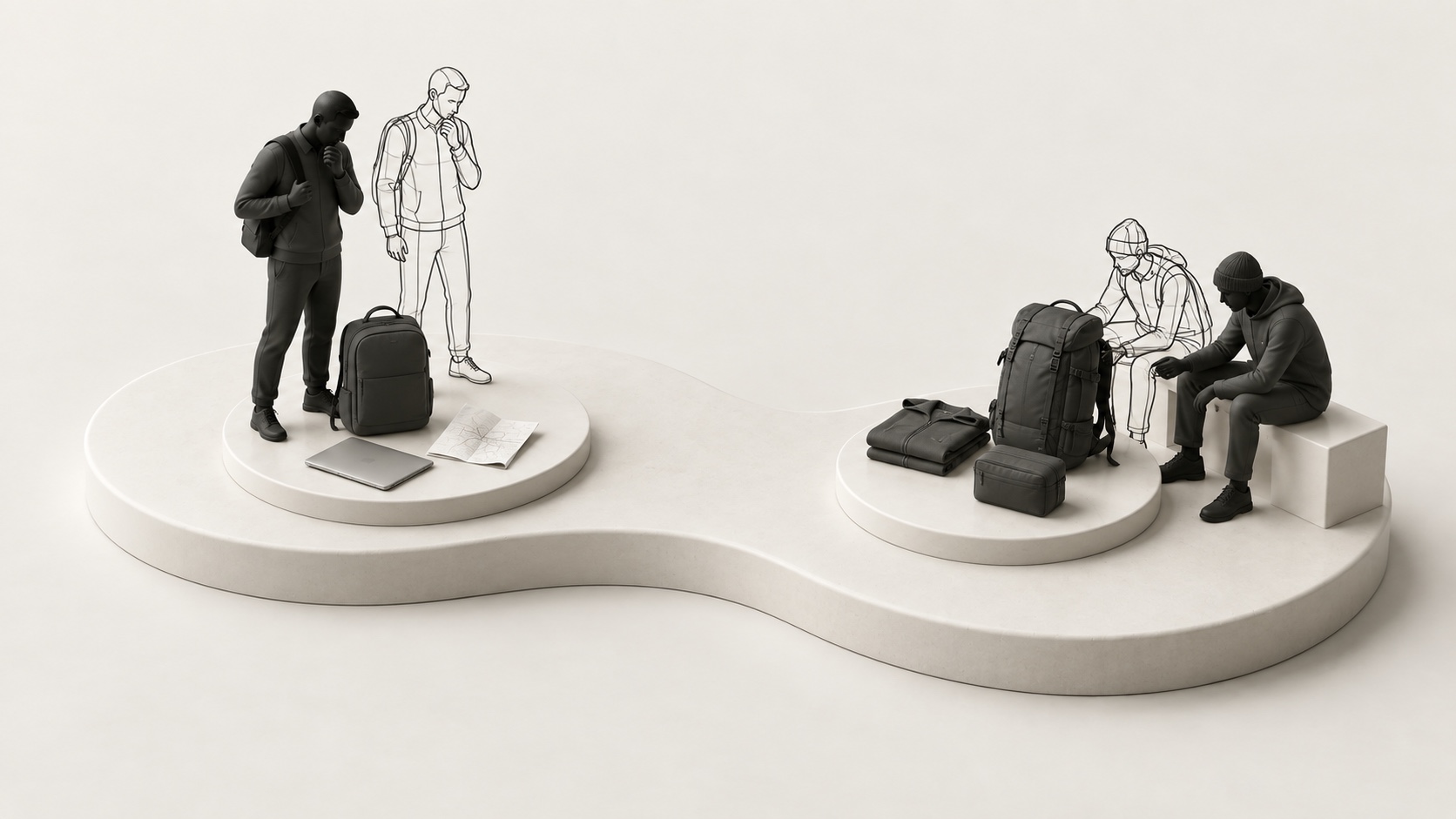
A synthetic persona is a simulated profile used to explore how a buyer might respond, based on stated information and assumptions. Useful profiles describe a buying situation and show which facts are sourced, calculated, assumed or unknown. This guide shows an annotated example and the checks needed before using its answers. A persona profile and a research platform solve different tasks. Our AI market research tools comparison shows which workflows collect new answers and which analyze or simulate them.
Evaluating the managed study? See synthetic audiences for Sapien’s product approach, then use this guide to check how the audience is built and the evidence your question needs.
Synthetic personas vs digital twins
For both synthetic personas and digital twins, check the evidence behind the representation. For example, Dovetail describes its Digital Twins as models of customers and segments built from calls, tickets, surveys and research, with answers linked to those sources.
Compare what each representation covers, its records, how current they are and which results have been tested. Existing-customer evidence may miss prospective commuters. Check that either model supports the audience and comparison before trusting the label.
Example: building a backpack-buyer profile
The example compares replacing a backpack for a laptop commute with buying one for occasional weekend trips. Those situations need different space, routines and evidence. Keep facts, calculated fields, assumptions and unknowns visible, then test the result the decision depends on, such as a concept ranking or answer distribution.
This hypothetical tutorial uses invented records. “Grounded” therefore means traceable to those records. Assuming the current backpack is damaged supplies a reason to replace it. Check that assumption before adding more imagined preferences.
Field type | Details |
|---|---|
Grounded attribute | Meaning: Comes from an identified source with permission and applicable scope Example in the commuter profile: Backpack category traced to the example interview record |
Derived field | Meaning: Calculated or coded from identified evidence Example in the commuter profile: Two backpack purchases counted within the dated record window |
Assumption | Meaning: Added to define a scenario Example in the commuter profile: “Considering replacing a damaged backpack” |
Unknown | Meaning: Information the sources do not establish Example in the commuter profile: Unrecorded household spending priorities |
A population statistic can ground a distribution without establishing an individual fact. If 30% of an audience reports a behavior, you cannot append that behavior to every persona and still claim to represent the audience. Similarly, a demographic category should not automatically determine beliefs, preferences or circumstances. In demographic segmentation, population descriptors set context for a group; claims about an individual still need their own support.
Keep the source with every profile field
The editable JSON profile shows all four field types. Its bag category points to the example interview. Purchases T2 and T3 fall within the year ending October 5, 2026; older T1 does not. The derived count is two. That does not show damage or a replacement need, which remains an assumption. Last brand and price preference stay unknown because neither is recorded. Each field keeps its source, date, scope, permitted tasks and unsupported conclusions.
Complete annotated profile
Copy this JSON as persona-schema.json to adapt the construction example. Keep the source records, date window, field statuses, null values and unsupported conclusions attached to the fields they qualify.
{
  "example_status": "Fictional teaching profile; not a customer record or Sapien implementation",
  "profile_id": "fictional-commuter-01",
  "representation": "invented individual scenario",
  "fields": {
    "commute_mode": {
      "value": "public transit",
      "status": "assumption",
      "source": "fictional scenario author",
      "date": "2026-10-04",
      "scope": "this scenario only"
    },
    "bag_use": {
      "value": "carries a laptop",
      "status": "assumption",
      "source": "fictional scenario author",
      "date": "2026-10-04",
      "scope": "this scenario only"
    },
    "replacement_occasion": {
      "value": "existing bag damaged",
      "status": "assumption",
      "source": "fictional scenario author",
      "date": "2026-10-04",
      "scope": "vary in sensitivity test"
    },
    "last_brand": {
      "value": null,
      "status": "unknown",
      "source": null,
      "date": null,
      "scope": "must not be invented"
    },
    "price_preference": {
      "value": null,
      "status": "unknown",
      "source": null,
      "date": null,
      "scope": "must not be inferred from commute mode"
    },
    "current_bag_category": {
      "value": "backpack",
      "status": "grounded",
      "source": "fixture-interview-01",
      "source_path": "facts.current_bag_category",
      "date": "2026-10-04",
      "scope": "Traceable to an invented interview fixture; not a real customer fact."
    },
    "backpack_purchases_last_365_days": {
      "value": 2,
      "status": "derived",
      "source": "fixture-transactions-01",
      "source_path": "transactions",
      "date": "2026-10-05",
      "derivation": {
        "operation": "count category=backpack transactions with 2025-10-05 < date <= 2026-10-05",
        "included_ids": [
          "T2",
          "T3"
        ],
        "excluded_ids": [
          "T1"
        ]
      },
      "scope": "Computed from invented records only; does not establish population frequency or active replacement need."
    }
  },
  "permitted_teaching_task": "Compare reactions to explicitly described backpack concepts",
  "unsupported_conclusions": [
    "Human population prevalence",
    "Physical comfort",
    "Observed purchases",
    "Individual prediction accuracy"
  ],
  "run_log_fields": [
    "profile_version",
    "prompt_version",
    "stimulus_version",
    "model_identifier",
    "run_identifier",
    "output",
    "review_notes"
  ],
  "schema_version": "teaching-v2",
  "provenance_notice": "Every source record below is invented. Grounded and derived describe traceability within this fictional fixture, not real human evidence or actual Sapien grounding.",
  "reference_date": "2026-10-05",
  "source_records": {
    "fixture-interview-01": {
      "record_status": "invented teaching record",
      "recorded_date": "2026-10-04",
      "facts": {
        "current_bag_category": "backpack"
      },
      "permission_scope": "fictional fixture only; no real personal data"
    },
    "fixture-transactions-01": {
      "record_status": "invented teaching records",
      "transactions": [
        {
          "transaction_id": "T1",
          "date": "2025-03-10",
          "category": "backpack"
        },
        {
          "transaction_id": "T2",
          "date": "2025-11-20",
          "category": "backpack"
        },
        {
          "transaction_id": "T3",
          "date": "2026-07-08",
          "category": "backpack"
        }
      ],
      "permission_scope": "fictional fixture only; no real personal data"
    }
  }
}
For a real project, give source records stable identifiers instead of copying unnecessary personal information into a prompt. Record how the audience was constructed, which information was omitted and whether the profile describes an individual, a group summary or a supplied scenario. These are different objects and require different validation.
Research illustrates why grounding matters. The 2024 version of Park and colleagues’ agent study built representations of 1,052 people using qualitative interviews and evaluated them against those individuals’ responses. That design used detailed information about each person. It does not establish that a short demographic sketch reproduces the same person or that a commercial persona has equivalent accuracy.
Check whether an assumption creates the answer
Use these probes on the backpack profile:
- Ask what is known about the last purchase. An acceptable answer can report the dated transaction fixture and its limits, but should preserve “unknown” for the last brand or unrecorded purchase details.
- Ask why the person prefers an expensive bag. The profile contains no established preference for expensive products, so the response should not treat one as a fact.
- Remove the assumption that the existing bag is damaged and repeat a replacement-interest question. A material change identifies dependence on that scenario assumption.
- Change only the order of two concept cards. Check whether the preferred offer changes and record the variation.
- Ask about an unavailable product detail, such as strap comfort. The response should distinguish expectations from physical experience.
- Inspect opposing and low-interest responses. A population that always endorses your concepts may be reflecting the prompt or selection process.
These probes can find failures, but passing them does not certify a valid population. Log the prompt, profile, model/version where available, material shown and output so you can check surprising results.
Check the result your decision uses
Choose reference questions for the decision. To compare concept rankings, test agreement on concepts kept out of construction and on relevant buyer groups. To estimate answer shares, compare them with suitable human reference results and check errors within groups. A convincing explanation cannot substitute for those tests.
Keep some evidence out of construction. If the same answers build and judge the persona, matching them may just repeat its inputs. Report failures and changes from other reasonable profiles, not only the best match.
Use our case-level validation comparisons to inspect the reference question, response source and disagreements before treating a model result as evidence for your decision.
Vary profiles using evidence
A persona is not a population weight. To compare audiences, define how profiles differ, which combinations have supporting evidence and which people or situations are missing. Giving every profile an assumed replacement need does not measure category demand. An audience-level distribution does not prove one person’s unrecorded preferences.
A profile can explain an answer plausibly while failing a ranking or response-share test. Report those capabilities separately, examine important failures within groups and keep reference answers outside construction. The JSON schema shows how the profile was built; it does not validate its responses. Our guide to how accurate synthetic users are shows the human comparisons behind that check.
The backpack decision needs more than one convincing profile
For the backpack, compare the same complete offer across commuter and weekend-use scenarios. If changing the assumed damage changes replacement interest, you’ve learned about dependence on that assumption; you haven’t measured category demand.
Synthetic profiles can support simulated comparisons of how different contexts affect an offer when construction and task-specific validation fit the decision. A single profile is a construction example; it is insufficient to describe a whole audience distribution. Keep the difference between a simulated response, a reported human experience and an observed action when presenting findings.
Sapien runs team-led research with distinct simulated respondents built from data and returns distributions, segment differences, explanations and recommendations. The profile above is a teaching example, not a description of Sapien’s implementation. In a Sapien introduction, ask how the proposed audience and validation fit your buying decision. Our silicon sampling guide develops the validation design; our synthetic-versus-human-respondents guide helps choose the evidence source.


