Packaging Design Testing: 7 Methods, Metrics and Tools
Packaging design testing shows whether shoppers notice, understand and choose a pack before print. Compare seven methods, useful metrics, costs and tools.
Packaging design testing shows target shoppers candidate pack designs, beside today's pack when there is one, to see which they can find, understand and want without losing the cues existing buyers use. Replace the current design only when a candidate clears the shopper and purchase checks agreed before testing; otherwise revise the candidate or keep today's pack.
How to test packaging designs with consumers online
- Define the artwork decision: an early direction, a final design or a replacement for the current pack. Save the complete copy, quantity, price and artwork version.
- Choose the relevant buyers and encounter. Current buyers, category users and potential switchers can need different information; a shelf, listing thumbnail and product page expose different details.
- Choose the exposure for the question. Use one complete design per buyer for independent understanding and appeal, or a matched competitive shelf task for findability and choice in that setting.
- Match the display conditions across candidates: size, crop, price, position, neighboring products, device and any supporting listing text. Retain the current pack when replacement is the decision.
- Collect unaided recall and interpretation before close inspection or explanatory prompts. Then diagnose the brand, category, quantity, promise and reason for choosing or rejecting the pack.
- Read each measure with its answering base and source. Give the designer the specific element to change, then retest the revised artwork under comparable conditions. Use actual packages and people for handling or physical-use questions.
Shelf testing and monadic pack testing: metrics and costs
A shelf test checks whether shoppers can find and choose a pack among competing products. It can record the correct first selection, errors and time-outs for a defined task. A monadic test shows each buyer one complete design, then compares understanding and appeal across separate groups. Ask for a quote covering the setting, recruitment, valid answers per design and analysis. Neither test turns stated preference into a sale.
Method | Evidence, use and cost drivers |
|---|---|
Shelf-context testing | A human shopping task with matched shelf positions and neighboring packs. Use it for findability and choice in that encounter. Cost depends on environment build, markets and recruitment. |
Each buyer sees one complete pack. Compare understanding and appeal across independent groups. Budget for valid responses per design and segment. | |
Sequential monadic testing | Each buyer evaluates several packs in a balanced order. Useful when repeated exposure fits the question. Include order checks and questionnaire length in the quote. |
Comparative choice | Buyers choose between the displayed alternatives and explain why. Efficient for a focused relative choice; it does not estimate isolated first appeal or market share. |
Qualitative pack interviews | Probe how people interpret wording, imagery and quantity. Recruitment, moderation, transcription and analysis determine the engagement cost. |
Attention and eye-tracking research | Observe gaze with people or use a separately labeled predictive attention model. Confirm which source you are buying and whether it answers the shelf task. |
Synthetic population research | Compare modeled pack interpretations and reasons across defined buyer groups. Agree grounding and task-relevant validation; reserve handling and observed buying questions for people and field evidence. |
Compare quotes for the same artwork, audience, display conditions and report. A price per response may cover only part of the work. Check whether it includes design, recruitment and interpretation before comparing it with a managed-study quote.
What should a packaging testing report show?
The existing Chunk Nibbles graphic compares a simulated population of 1,000 with a 456-profile group whose main buying reason is taste or trying something new. It shows one report format, not a complete study or packaging-test result. Ask for the full question, offer and display conditions, buyer definitions, artwork versions and measures in your packaging report.
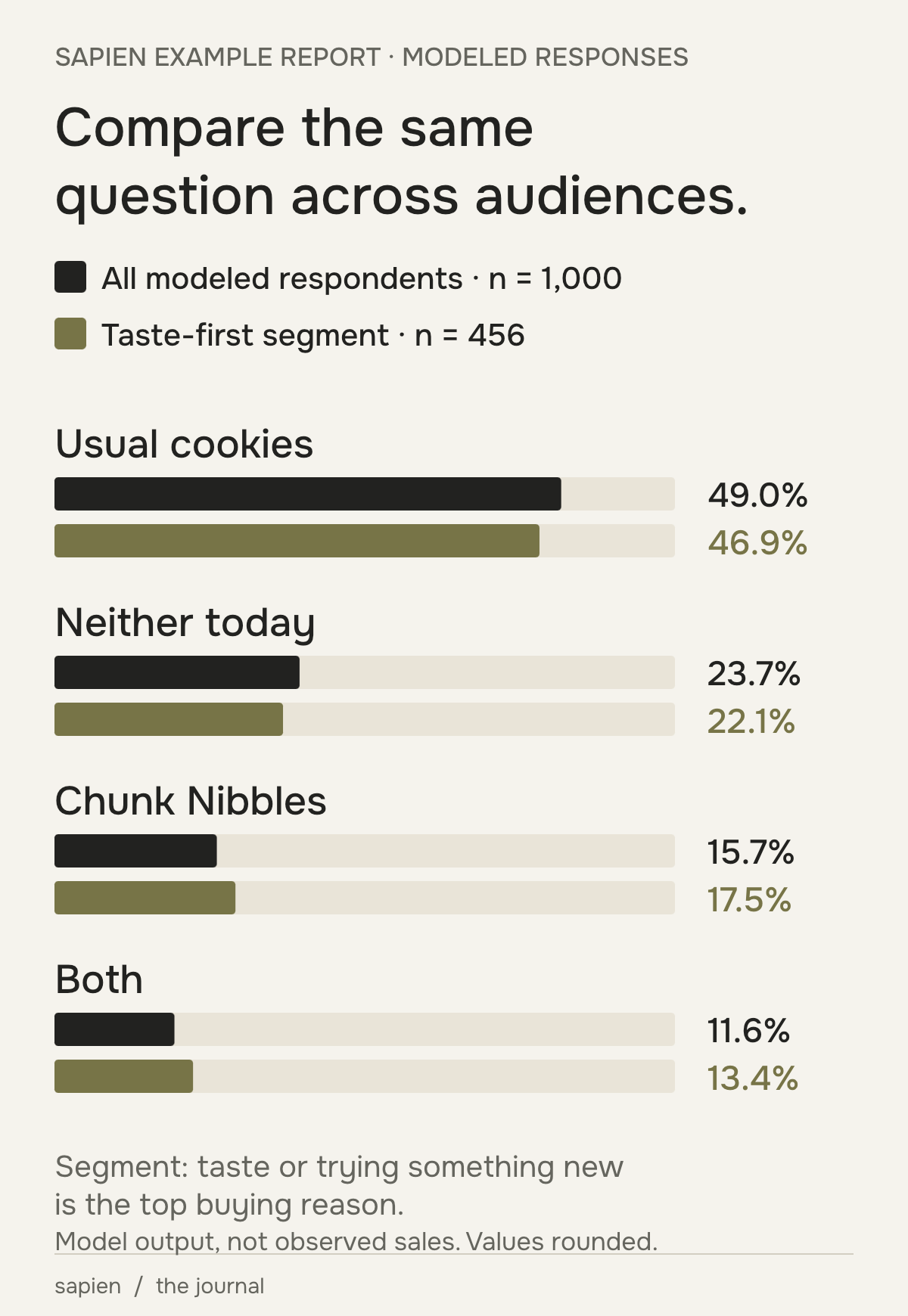
View an example study to see the audience, offer and findings before planning your own.
What should a packaging test tell you?
Start with the decision. A new brand must explain its category and reason to buy. A redesign must also keep the cues current buyers recognize. A format change may need to explain quantity or use. Each calls for different evidence, even when the pack is the same.
Your decision | Evidence to ask for |
|---|---|
Which design should progress? | How each candidate is understood and considered by the intended buyers, plus reasons for the difference. |
What should the designer change? | The specific wording, image or hierarchy behind a misunderstanding or missing fact. |
Can we replace the existing pack? | Recognition and choice alongside the current pack in the relevant shopping context. |
Does the pack work after purchase? | Observed opening, dispensing, storage or other use with the physical package. |
Connect each finding to an artwork change. “Shoppers preferred the new pack” leaves the designer guessing. “The product is clear, but buyers miss the quantity at listing size” names the element to change and where it must work.
Early directions and finished artwork answer different questions
Early on, compare different directions: an occasion, a functional benefit, a brand treatment or a new format. Find what deserves more design work and what buyers need explained. Match the level of finish so polished artwork does not beat a rough sketch simply by looking more complete.
Later, test the shortlist with the actual words, quantity, images and shopping setting. The result should help you choose the design to produce and name any remaining edits. Include the current pack when deciding whether to replace it. Check the edits before approving the artwork.
An early preference can justify developing a direction. It cannot approve details missing from that concept. In a final comparison, let the team check the version that will reach shoppers.
Tropicana's redesign and reversal
Tropicana's orange juice carton illustrates a grocery brand's replacement decision: can new artwork retain the cues existing buyers recognize?
In 2009, BevNET reported that Tropicana scrapped a redesigned carton. Its familiar orange-with-a-straw image had become an image of juice; officials had confirmed negative consumer reaction in interviews with The New York Times.
Here's a memo from that public record, not an unpublished Tropicana study:
Memo field | What this report supplies |
|---|---|
Current versus candidate | Familiar carton treatment versus redesign. |
Recognition cue | The familiar orange-with-a-straw image was replaced by an image of juice. |
Reaction in the report | Officials had confirmed negative consumer reaction. |
Evidence for a replacement gate | The report supplies no measured recognition result, controlled purchase comparison or pre-launch test protocol. |
Memo call on this published record | Keep the current pack for full rollout; revise a candidate before reconsidering replacement. The recognition and purchase evidence cells are unfilled, so the replacement gate cannot pass on this record. |
Decision on record | Redesign scrapped; pre-launch gates unreported. |
That's the memo's job: a redesign that removes the main recognition cue needs an existing-buyer recognition result and a purchase checkpoint before full print. This is our retrospective call under the memo, not a reconstruction of Tropicana's private research or approval process. The reversal supplies neither a causal sales estimate nor proof that a particular pre-launch test would have changed the outcome.
Book a pack comparison call to agree which candidates to screen and which shopper evidence would block print approval.
A pack-replacement decision memo
The memo below compares today's pack with each candidate and records the evidence needed for a replace, revise or keep call. Fill in the gates before collecting answers. Appeal can't outweigh a failure to explain the product or a loss of recognition among existing buyers.
Decision and materials: [product and market]; [current artwork version]; [candidate versions]; [print deadline]; [decision owner].
Buyers and encounter: [current buyers and category shoppers, reported separately]; [store shelf, listing or product page]; [display conditions]; [same product, quantity and price, or the offer differences being tested].
Findability. Measure correct first selection in the same directed shelf task, retaining all valid displayed tasks in the base. Current pack: [pending result, valid base, evidence source]. Each candidate: [pending result, valid base, evidence source]. Gate: [minimum acceptable rate or maximum loss versus current]; [time limit]; [uncertainty rule].
Comprehension. Ask for an unaided explanation of the category, quantity and main promise. Current pack: [pending result, valid target-audience base, evidence source]. Each candidate: [pending result, valid target-audience base, evidence source]. Gate: [correct meanings]; [minimum acceptable rate]; [maximum tolerated rate of each blocking misunderstanding]; [uncertainty rule].
Existing-buyer recognition. Record correct brand and product identification after independent exposure. Current pack: [pending result, valid existing-buyer base, evidence source]. Each candidate: [pending result, valid existing-buyer base, evidence source]. Gate: [minimum acceptable recognition]; [maximum loss versus current]; [uncertainty rule].
Appeal. Use the same labeled scale after independent exposure and show its full distribution. Current pack: [pending result, valid category-shopper base, evidence source]. Each candidate: [pending result, valid category-shopper base, evidence source]. Gate: [minimum improvement worth changing the pack]; [uncertainty rule]. Show current buyers separately.
Uncertainty plan: [confidence level and interval method]. A confidence interval around a rate describes uncertainty in that rate; an interval around a difference describes uncertainty in candidate minus current. Decide which range must clear each gate. A point estimate inside the allowed loss doesn't pass if its interval crosses the failure boundary.
Purchase checkpoint: [actual purchase measure]; [current-versus-candidate comparison]; [eligible exposure base]; [price, promotion, stock and channel controls]; [minimum acceptable outcome]; [uncertainty rule]. Keep trial and repeat purchase separate if both matter. A stated-intent rating doesn't fill this line.
Evidence attached: [artwork and display files]; [exact tasks and questions]; [valid bases and exclusions]; [uncertainty]; [supporting open answers]. Label each result observed or simulated and keep those sources separate.
Call and reason: [replace / revise / keep]; [the rule that determined the call]; [specific artwork edit, if any]; [owner and next evidence checkpoint].
Replace when a candidate passes every required shopper gate, offers the improvement the team required and clears the actual-purchase checkpoint before the full print commitment. Revise when a candidate offers a useful direction but fails a repairable gate; name the element to change and retest that version. Keep today's pack when no candidate clears the rules, including when uncertainty leaves the replacement case unresolved. If candidates tie, use the production cost or risk rule agreed in advance rather than inventing a preference from a small score difference.
A real-shopper validation brief
Decision and materials: [current pack and shortlisted candidate files]; [replacement objective]; [channel and display]; [gates from the memo].
People: Recruit category shoppers who could buy the product and enough existing buyers to read recognition separately. Set the sample for the smallest difference that would change the decision and the uncertainty the team can accept; a total response count alone doesn't protect a small buyer group.
Tasks: Randomly assign people to matched displays containing the current pack or a candidate. Run the directed finding task before a close-up or explanation. In separate independent-exposure groups, ask what the pack contains and promises before recognition and appeal. Keep question wording, display size, price and neighboring products comparable.
Readout and next step: Return the memo by design and buyer group, with valid bases, errors, time-outs, rating shares and uncertainty. Agree a limited actual-purchase comparison before the full print commitment, holding the offer and availability comparable. If that checkpoint can't be completed, keep the full replacement decision pending and state what a limited trial can resolve.
The buyer and shopping encounter shape the comparison
“Consumers” is too broad. Name whose choice matters: current buyers, competing-product buyers, occasional category users or people new to the category. Specify the market and purchase channel. Compare groups when their expectations could change the design recommendation.
An existing buyer and someone new to the category may use different cues. Show category experience beside their answers. A strong overall result can hide confusion among the buyers the replacement needs.
Match the display to the part of shopping you can change:
Encounter | What the comparison needs to preserve |
|---|---|
Ecommerce thumbnail | Display size, crop, product title, neighboring listings and information available before a click. |
Shelf context | Relative pack size, position, neighboring products and the same viewing conditions. |
Product-page inspection | Image quality, angles and the supporting description available to the shopper. |
Save the full display with each artwork version. A listing title may explain the category when its image does not. On a shelf, the pack must explain itself in that setting. Recommend changes to the element your team controls.
A score is useful only when you know the shopping task behind it. Ipsos' Simstore Pack evaluates packaging in simulated store and ecommerce environments, combining behavioral and attitudinal measures. Ask the supplier to show that environment and task. A choice made there remains a simulated shopping choice.
First impressions differ from close inspection
To test first impressions, show the pack under the agreed conditions, remove it and ask what people remember before showing it again. Record remembered brand, category and message. Choose and report the display duration. No one duration fits every shelf or listing.
Then let buyers look closely at the pack. Ask what they think they would get, how they would use it and what is unclear. Use this second look to find design problems. Keep it separate from unaided recall.
Separate a quantity fact that shoppers miss from one they read but misunderstand. Change visual emphasis for the first problem and wording for the second. If shoppers understand the quantity but want a different amount, the problem concerns the offer. One low “clarity” score would hide the difference.
If the preference is for a different pack size, our shopper research guide follows the range, shelf-space and substitution decision.
The same discipline applies to taste and claims. A statement can be believable while communicating a promise you did not intend. Compare the inferred promise with what the product can deliver. Our claims testing guide follows that interpretation through to the evidence and wording decision.
Each measure should explain an artwork decision
Attention does not tell you whether shoppers understand the product. Understanding does not tell you whether they want it. Choose measures for the decision and show how many eligible answers each result uses.
Measure | What the result can tell you |
|---|---|
Category and quantity | Whether buyers correctly explain what they receive. Separate a missed fact from an incorrect interpretation. |
Brand recall and recognition | What buyers remember without the pack present, and whether they can identify the brand when shown it. These are separate tasks. |
Benefit and claim interpretation | Which promise buyers infer and what they expect the product to deliver. Compare it with the intended, supported meaning. |
Appeal, trust and perceived value | How buyers evaluate the offer at its displayed price, with reasons that identify what to preserve or revise. |
Relative preference or stated purchase intent | Which candidate is favored in the shown set, or reported willingness under the stated offer. Keep the alternatives, wording and scale with the result. |
Observed shopping or use behavior | Actions recorded from people in the research setting, such as finding the pack or opening its seal. State the setting and task. |
For preference, count responses from the stated audience that completed the comparison and use that total for the percentage. Report human and simulated responses separately. For understanding, define a correct interpretation and keep the original open answers. If you combine intent ratings, keep the full scale and say which categories were added. These details explain what “better” means.
Match business conclusions to the evidence. Willingness to buy is different from a purchase. Before using a benchmark percentile, check that its audience, design stage, shopping setting and measure fit your study.
The question determines the method
Independent exposure: can each design stand on its own?
To assess each pack on its own, randomly assign target buyers to one complete candidate each. This is a monadic test. Ask about understanding and appeal before anyone sees the other design. Use it to decide whether either pack is ready for the next stage, including the possibility that neither is.
Keep the product facts, price and encounter matched when the purpose is to compare the artwork. If the format or quantity is the change you are investigating, keep that difference and report the result as a comparison of the complete offers. Our concept testing methods guide explains the exposure choices in more detail.
Direct comparison: which direction should we refine?
Showing the current pack and a candidate together helps buyers explain which they prefer. Use the comparison for a focused design choice. The winner only beats the alternatives shown; a forced choice still produces one when both have problems. Check what people think each pack means before approving it.
A preference for the redesigned pack does not tell you whether buyers understand the product or quantity. Check those details before turning the preferred direction into final artwork.
Shopping context: can buyers find and choose it?
A competitive shelf or listing task can test recognition, navigation and choice in that setting. Include the current pack if replacement is the decision. Match price, position, neighboring products and availability, or make them an explicit part of the test. Otherwise, an apparent artwork advantage may come from another difference.
To check where people look, use a measured attention method and check what it records. Remembering an element, clicking an image and fixing the eyes on it are different observations. A simulated interpretation does not measure human eye movement.
Physical use: does the package deliver the experience?
To assess opening a seal, gripping a bottle or resealing a pouch, use the package itself. If label curvature may affect readability, include the physical shape in the test. Observe relevant people performing the task and investigate what creates difficulty. Ipsos' packaging research spans design development and later use research; confirm which stage and material the study includes.
Physical protection in distribution is another task. ISTA's procedures address package and product integrity and transport hazards. If your question is whether the pack survives shipment, choose that evidence alongside the consumer study.
If the proposed package needs to circulate again, our sustainability market research guide follows the return, cleaning and filled reissue system and the independent environmental evidence the offer requires. A usable pack or an appealing message alone cannot approve that system.
Can an existing buyer find the pack they came for?
Consider a hypothetical brand, Hearthfield, and its rolled-oats bag. Existing buyers compare today's pack A with a refreshed candidate B; the objective is to improve appeal while keeping the regular restocking task easy. The following numbers are illustrative teaching inputs, not Tropicana data or results from a study run by Sapien.
Recruit existing buyers of Hearthfield oats for a restocking task. Randomly assign each person to one competitive shelf containing either A or B, with identical neighbors, facings, position, prices, image size and device conditions. The other design is absent. Define the target as the named rolled-oats product; keep other products distinguishable and available in both displays. Kantar's packaging guidance describes competitive shelf testing as a distinct stage from screening early designs. The specific task and stopping rule here are choices for this example, rather than Kantar's protocol.
Ask: “Find the Hearthfield rolled oats you would restock. Select it when you have found it.” Use the same product name in each group's instruction. Do not highlight the pack, describe its location or show a close-up first. This is directed retrieval of a named product, not unaided brand recall or evidence that an unprompted shopper noticed it. GOV.UK's task-design guidance recommends relevant goals and neutral instructions that do not reveal how to complete the task.
Start timing when the full shelf is visible. Stop at the first selection or the planned 20-second limit. Record the product selected and elapsed time. A wrong first selection stays wrong even if the person corrects it in discussion. Record loading failures separately. Try out the task and time limit before using them for a real decision.
First-search outcome | Pack A / Pack B |
|---|---|
Correct first selection within 20 seconds | A: 30 of 40 B: 24 of 40 |
Wrong first selection | A: 6 of 40 B: 4 of 40 |
No selection before the limit | A: 4 of 40 B: 12 of 40 |
Keep every valid displayed task in its group's denominator. Correct first selections are 75% for A and 60% for B. B has fewer wrong selections but more time-outs. You can combine them as “not successful” for a headline, then show them separately to guide the designer. A real study must assess uncertainty for its sample and assignment before treating the gap as a population advantage.
After the search, show both packs to all 80 participants in a balanced order and ask preference separately. Suppose 56 choose B, or 70%. That later preference does not replace the search result. People now have a different task and have seen both packs. Neither measure is a sale.
If successful B finders are faster, report their timing beside the lower success rate. A median for 24 successful people leaves out the other 16. It does not describe everyone's search time. Show time-outs and errors rather than averaging only easy successes. Click timing measures selection, not eye fixation.
The memo call is revise B while keeping A for the present rollout. The later preference, 56 of 80, supports developing B; the earlier search result, 24 of 40, leaves a problem finding it. Investigate the cues existing buyers use and retest the revision with fresh participants. The counts don't show the cause or a population advantage. Sapien can explore simulated interpretations and revisions; claims about human search need an observed human task, and purchase evidence is still required before replacement.
Packaging tools serve different research jobs
Choose by the work your team needs done. Software organizes a study; a managed provider may also design it and explain the findings. Ask for a demonstration using your candidates, target buyers and required report.
Research job | Route to compare |
|---|---|
Explain interpretations and compare target groups | |
Screen directions, then assess a competitive short list | |
Run an independent-exposure artwork study internally | |
Resolve a focused preference with written reasons | |
Investigate the shopping environment and physical use |
If your team will run the comparison, our concept testing tools guide helps you compare independent-exposure workflows with a focused preference task.
Sapien: from interpretation to an artwork recommendation
Sapien compares pack designs with a simulated audience built from data and returns an interactive report with recommendations. Numbers show where buyer groups differ; written answers help explain how they read the pack and why they would choose or reject it. Connect a misunderstanding to the wording, image or hierarchy the designer can change. Agree the supported image format and follow-up. Our comparisons with human research show tested tasks, paired results and limits.
Use simulated audiences to shortlist directions and explore possible misunderstandings. Real shoppers must validate findability, comprehension, recognition and appeal; actual purchase evidence must resolve the commercial checkpoint before the full print commitment. Physical handling and measured human attention need their own methods. Simulated answers don't fill those evidence cells.
Kantar: early screening and competitive testing
Kantar PackEvaluate distinguishes early screening from deeper competitive testing, with self-serve and serviced options. Its testing offer includes recall, recognition, purchase intent and competitive displays. The advertised heatmap uses mouse tracking. Check the module, audience and readout included; mouse activity should keep that meaning when your team interprets attention.
SurveyMonkey LaunchPad: guided one-design exposure
LaunchPad Packaging Testing accepts up to ten PNG or JPG concepts and shows each respondent one design. It offers attribute scorecards, statistical comparisons and exports. Confirm own-contact collection and the cost of targeted human responses under the plan you would purchase, along with eligibility, question order and benchmark fit. Its Idea Screening solution exposes people to multiple concepts and serves a different stage.
PickFu: a focused preference and its reasons
PickFu supports packaging comparisons with targeted human respondents, votes and written reasons. Consider it for choosing between concrete directions and investigating what drove the choice. Confirm the target criteria and response base. A preference within the supplied alternatives answers that comparison; use a separate design when independent appeal is the decision.
For that choice of workflow, compare Sapien and PickFu on a targeted human preference test versus a managed simulated study.
Ipsos: shopping context and physical use
Ipsos describes work from design development through competitive shopping settings and home use. Consider the proposed study when shelf navigation, a different sales channel or physical interaction matters. Check which participants, setting, package materials and analysis are included. Agree which result will answer the design or format question.
For all five providers, check a sample report: the design shown, audience, measure, findings and recommended edit. Agree who will turn conflicting feedback into a decision.
Give the revised design a specific job
Give each revision a testable job: restore a familiar brand cue, make quantity legible at listing size or correct an unintended promise. Save the exact artwork and say which result would justify keeping the change.
Retest the revised version at the same size and in the same setting. If the information is still missed, change its position or emphasis; if it's read but misunderstood, change the wording. A larger image or extra explanation changes more than the pack. If taste is a purchase risk, compare the expectation the pack creates with actual product experience.
Artwork approval needs a rule
Decide which misunderstanding would block approval and which appeal difference would justify a new direction. Use the business decision, current pack and cost of being wrong to set the rules. A pass percentage from an unrelated category will not settle this choice.
Read results by design and important buyer group. Show how many people answered, the exact question and the full rating shares. Keep the open explanations, including conflicting answers. An overall average can hide confusion among the buyers you need.
Name the candidate to develop, exact edit, supporting evidence and any question needing another method. For a redesign, show whether current buyers recognize the replacement. For a new format, explain what buyers think they receive and how it fits the purchase occasion.
The rollout answers the commercial question
If the business case depends on sales or repeat purchase, plan to measure them before rollout. Record price, promotion, stock, distribution and artwork version. These can all affect sales after a redesign. Use a controlled comparison where feasible and limit the conclusion to what it shows.
For ecommerce, comparable traffic and offers can support a test of product-page actions and purchases. For stores, agree the locations, periods and availability needed for a useful comparison. Check repeat purchase separately when the pack changes storage, dispensing or product experience.
Use the pre-launch study to choose and improve the pack. Use rollout evidence to check the remaining business question. Agree that next step before treating a strong research score as approval.
What determines cost and timing?
Cost depends on the designs, buying criteria, markets, languages, shopping setting and analysis. Flat artwork online is a different job from shipping prototypes for home use. A narrow audience or physical task adds recruitment and logistics that a software subscription does not cover.
Compare quotes for the same audience, designs, display conditions and report. Ask who prepares the materials, checks interpretations, writes the design brief and runs any follow-up. Allow time to approve the test artwork and check the revision. The useful deadline is when you receive a recommendation before print approval.
For a broader provider comparison, our market research services guide explains the work included in managed research and self-service software.
Questions about packaging design testing
How do you test packaging on shelf without in-store research?
Use a virtual shelf or ecommerce display with matched pack size, neighbors, position, price and device conditions. Give target shoppers a neutral finding or choice task. Record first selections, errors and time-outs using a rule agreed in advance. This measures behavior in that simulated setting. Physical handling and actual retail sales need separate evidence.
How can a small brand test packaging on a tight budget?
Choose the artwork decision that can change the next print run. Compare a small number of complete designs with the buyers who matter. Match the offer and display conditions. Ask what people understand before ratings. Get quotes for the same valid-answer count and report. Use physical or distribution tests for questions flat artwork cannot answer.
A packaging recommendation leaves the designer a next move
The final recommendation should name the pack to keep, revise or replace, the evidence behind that call and the artwork that will be printed. Leave the designer a specific change and the decision owner a clear approval boundary. A promising direction can advance to shopper validation; print approval follows the checks the team agreed before testing.