
Open vs Closed Questions: Differences & Examples
Twenty copyable questions, a format comparison and a missed-delivery example showing how to turn open answers into better survey options.
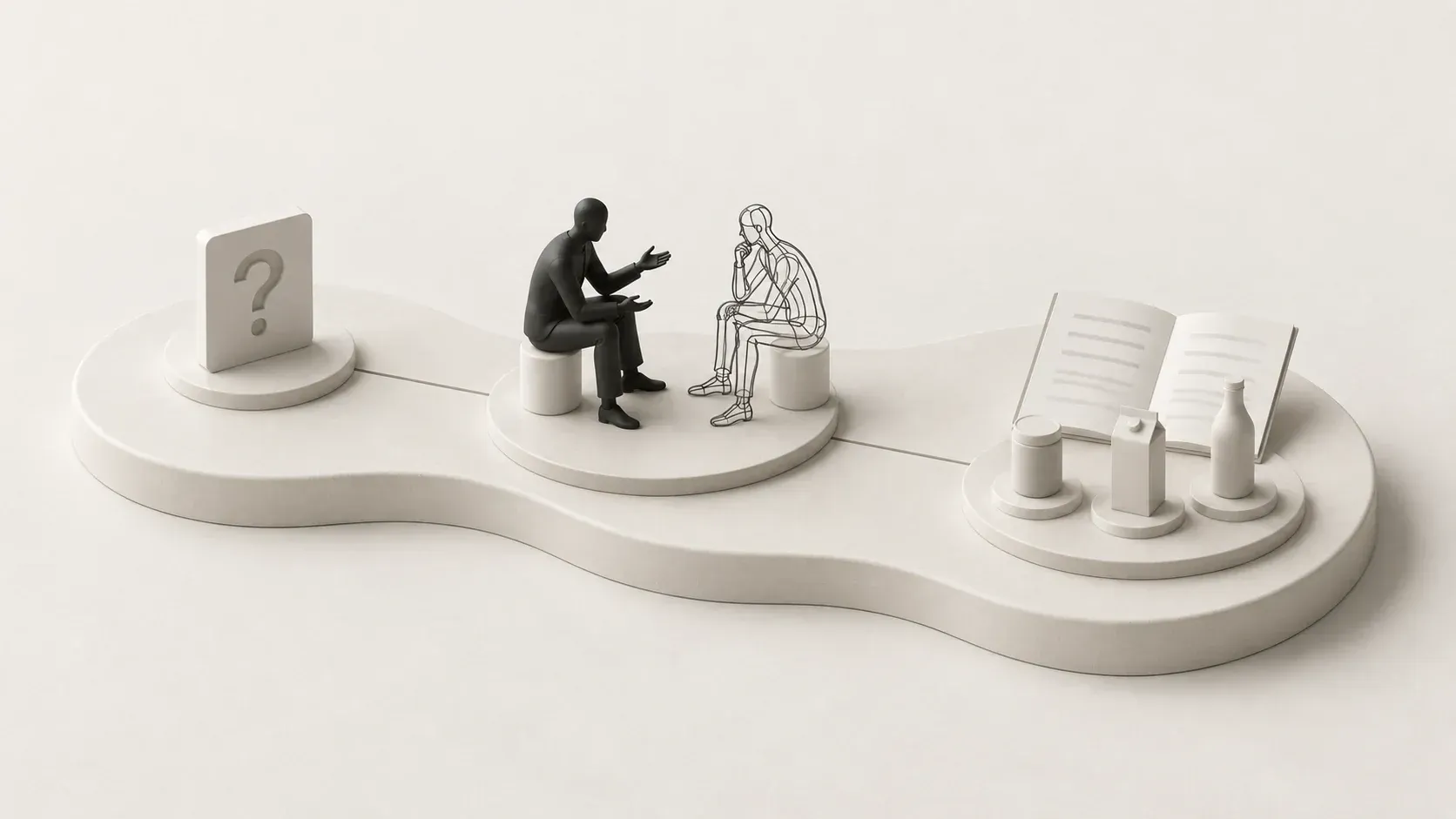
A customer misses a collection because the desk closes before they can get there. A questionnaire that offers only “could not find the collection point” would record the wrong problem. Open questions let people describe the event in their own words; closed questions measure defined answers consistently. Use both when the categories themselves need checking.
For a delivery brand’s marketing lead and agency researcher, the collection example poses a practical choice: investigate a clearer location message or a more usable collection-hours proposition. Before commissioning the next survey, agree which changes the service can deliver, which recipients should answer and when the marketing sponsor will review the evidence and approve the next investment.
Open-ended vs closed-ended questions: one question both ways
The open answer becomes a different closed choice
“I couldn’t get to the collection desk before it shut.”
Open code: collection access, not unclear location.
Which one best describes the main reason for the missed collection?
- Could not locate the collection point
- Could not reach it during opening hours
- Another reason
- Cannot recall
An open question lets people answer in their own words. A closed question gives them a fixed list to choose from. Pretest what buyers understand by each option before using this revised list. It is for the next survey; the earlier example did not use these options.
Format and question | What you get and how to read it |
|---|---|
Open: “Tell me what happened during your most recent missed delivery.” | An episode and the respondent’s explanation. You need to interpret and code the answer. |
Closed: “Which one best describes the main reason for your most recent missed delivery?” | A selection among defined categories. The supplied list shapes what the person can report. |
About this example: For the closed question, use options discovered and tested in the intended audience: not home during the window; did not hear the arrival; could not find the collection point; delivery went to the wrong address; another reason; cannot recall. These are illustrative options, not a validated taxonomy.
Define “missed delivery” and the recall period before fielding. If the question concerns delivery attempts that the recipient could not collect, do not combine those with a courier’s failure to arrive.
The open account can preserve a sequence or several obstacles. The closed main-reason item requests one selected category. Neither is universally better; their different outputs should serve different decisions.
Related guides: leading questions.
Let the unlisted answer improve the next instrument
Example response | Code and reason |
|---|---|
“I was on a work call and didn’t hear the buzzer.” | Code: Did not hear arrival Reason: The account reports not hearing the buzzer during a work call |
“The driver left it at number 18; I live at 16.” | Code: Wrong address Reason: Explicit location mismatch |
“I couldn’t get to the collection desk before it shut.” | Code: Collection access Reason: Not the same as an unclear collection location |
“I don’t remember.” | Code: Cannot recall Reason: Keep separate from missing response |
The third response reveals a gap in the proposed closed list. Add and test a collection-hours option if the study needs it. Do not force the response into “could not find the collection point” simply to keep the first codebook unchanged.
Write code definitions, inclusion/exclusion rules and handling of multiple reasons. Retain original text. If a question asks for the main reason, a multi-code analysis should not quietly become a single-choice percentage.
When to use open-ended vs closed-ended questions
Ask the unaided open question before showing the reason list so discovery is not merely a repetition of supplied choices. Then decide whether the next comparison needs one main obstacle or every obstacle. A single-main-reason result has one choice per substantive response; a multiple-response design can have overlapping option shares.
Pretest location and hours as separate meanings. Keep another reason and cannot recall where appropriate. Distinguish delivery attempts the recipient missed from a courier’s failure to arrive, and specify the recall period.
Save a new list version. The revised question can measure collection hours going forward; it cannot create a past selected response that the earlier instrument never offered. Preserve open text when the evolution of the categories matters.
Six closed-question formats for the next collection survey
The examples below concern a person’s most recent parcel-collection attempt in the past 30 days. Choose the format that supplies the needed output, then pretest its wording, options and routing. They are alternative examples, rather than six questions every respondent must answer. Preserve cannot recall, cannot judge and not applicable separately from a substantive choice or a blank response.
Format | Example and response design |
|---|---|
Yes/no | Dichotomous item: “Did you collect the parcel on your first visit to the collection point?” Yes / No. Route people who cannot recall outside these two substantive answers. |
Choice | Single-choice multiple choice, asked only after an unsuccessful first visit: “Which one best describes the main reason you could not collect the parcel on that visit?” Could not locate the point / Could not reach it during opening hours / Required collection document was unavailable / Another reason, please describe / Cannot recall. Test whether these categories cover the intended audience’s accounts. |
Rating | Ordered rating: “How easy or difficult was it to collect the parcel?” Very difficult / Somewhat difficult / Neither easy nor difficult / Somewhat easy / Very easy. Keep Cannot judge outside the ordered scale. |
Likert | Likert-type agreement item: “The collection point was open at a time I could use.” Strongly disagree / Disagree / Neither agree nor disagree / Agree / Strongly agree. One agreement item is not a complete multi-item Likert scale. |
Ranking | Priority ranking: “Which of these changes, if any, would have helped with this collection? Rank up to two, with 1 the most useful.” A map link marking the entrance in the collection message / Weekday closing at 8 p.m. instead of 6 p.m. / One text reminder the day before the collection deadline. Assume the same collection point and charge. Offer None would help and Cannot judge as exclusive routes; do not require an unwanted option to receive a rank. These are hypothetical changes to assess, not available service terms. |
Matrix | Rating matrix: “How easy or difficult was each part of the first collection attempt?” Rows: finding the collection-point entrance; arriving during its opening hours. Use the five ease labels above for each row, with Not attempted and Cannot judge outside them. Retain a separate answer for each row. |
These labels describe overlapping features of an instrument. A yes/no item is a closed choice; a matrix is a layout that can contain rating or agreement items. Keep an ordered response scale in order. A ranking supplies relative priority among the shown changes, while a rating records the judgment on each item; neither supplies the observed effect of changing collection hours.
Sixteen open-ended questions to adapt
Use this bank to select a short set for the same recent collection episode. Start with the broad account and use a follow-up only when the person’s answer makes it relevant. The question about a failed first plan applies only to people who reported one; a person who never collected the parcel needs no successful-collection follow-up. Preserve accounts of an easy collection as well as difficult ones.
Reconstruct the recent collection
- “Walk me through your most recent attempt to collect the parcel.”
- “How did you decide when to go to the collection point?”
- “What information did you use before leaving?”
- “What happened when you tried to collect the parcel?”
Check the message and its meaning
- “What did the collection message lead you to expect?”
- “How would you explain the collection instructions in your own words?”
- “What, if anything, was unclear before the visit?”
- “What additional information, if any, did you need?”
Understand help, obstacles and consequences
- “What, if anything, made collection difficult?”
- “What helped you collect the parcel, if anything?”
- “What did you do when the first plan did not work?”
- “How, if at all, did this collection affect the rest of your day?”
Find useful changes and contrary accounts
- “What change, if any, would have helped with this specific collection?”
- “Which part of this collection experience, if any, would you keep?”
- “What other collection arrangement, if any, did you consider?”
- “What have we not asked that matters for understanding this collection?”
Repair a leading question in either format
Original: “Why is our delivery service convenient?”
Open rewrite: “What worked well or poorly in your most recent delivery experience?” This permits an unfavorable account.
Closed rewrite: “How easy or difficult was it to receive your most recent delivery?” Very difficult; Somewhat difficult; Neither; Somewhat easy; Very easy; Cannot judge. This measures perceived ease, rather than the reason for it.
Follow-up: “What made it easy or difficult?” The open explanation helps interpret the rating without assuming a positive result.
Questions before fielding
Can I report percentages from open answers?
You can count coded responses under a defined codebook and base. State whether the unit is a respondent, an episode or a mention, and whether more than one code is allowed. A share within those responses does not establish how common the obstacle is in the customer population; recruitment and coverage still matter.
Do I need both formats in every study?
Use both when the decision needs an explanation and a comparable measure, with audience and recall period aligned. A question that adds no useful output can be removed. For the broader study choice, see our qualitative vs quantitative research guide.
Does a fixed answer list make a question neutral?
The wording can still supply praise, assume an experience or combine different judgments. Confirm eligibility and provide plausible unfavorable and unknown responses before testing how people interpret the item. Use our guide to leading and double-barreled questions when repairing those problems.
For the collection decision, the marketing sponsor and agency researcher should approve a versioned questionnaire, the eligible audience, the codebook and a dated readout. That readout should keep original episode accounts, selected main-reason shares and ease ratings separate, then identify which feasible change deserves the next test. A proposed collection-hours change still needs an appropriate implementation comparison before anyone claims it reduced missed collections.
See how Sapien builds populations and runs a study before deciding whether a modeled comparison fits your question.
For synthetic answers, preserve model provenance and remember that open fluency does not establish actual lived experience. Use our market research survey guide and our analysis guide. Discuss a managed synthetic questionnaire with Sapien when its grounding supports the decision.
Use the open explanation, ease rating and main-reason choice for their different decisions; report each as its own measure.
For more on writing these questions, see Pew Research Center’s question-writing guidance.
Related guides: qualitative interviews; Likert scales.